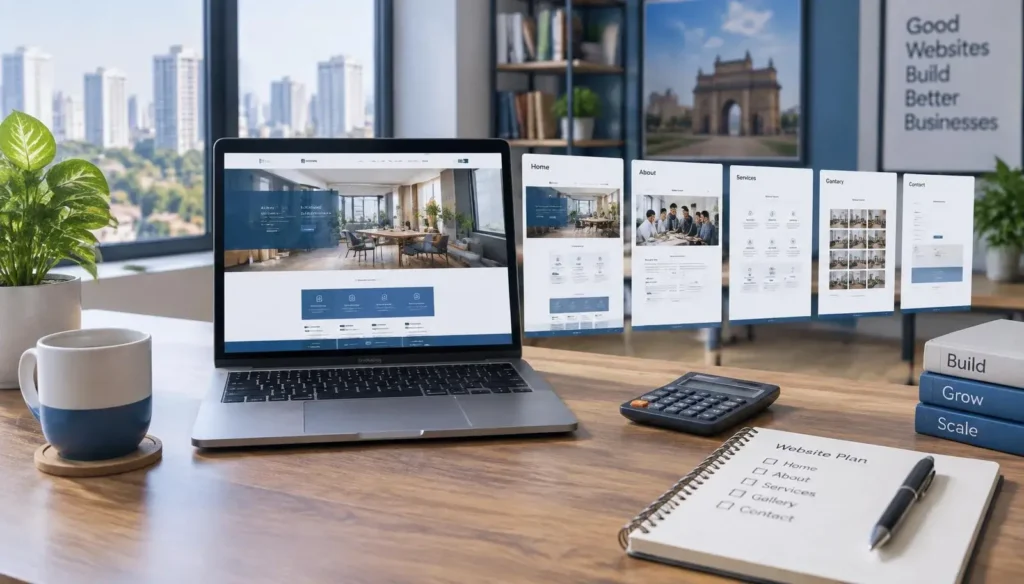


Cost, process and what converts: planning a mobile-first business website. Original illustration.
In this article
Planning five pages?
If you’re searching for website design India services, you’re probably asking three things: how much will it cost, how long will it take, and will the site bring enquiries or just look good? The answers depend on scope, process, and how well the site matches what your visitors need to do. This guide covers all three, and explains where needs differ between the Tricity region and international markets such as the US, UK, Canada, Australia and the UAE.
Why a well-planned website matters
For most businesses, the website is the first place a potential customer checks before calling, messaging, or visiting. A clear, fast site builds trust before any conversation starts. A confusing or slow one sends visitors to a competitor, often without you ever knowing.
Planning matters more than decoration. The sections below explain what to budget, how a good project runs, and what to focus on first.
What website design India projects include
Website design is more than visuals. A complete project usually covers:
- Strategy and structure: goals, audience, page hierarchy, navigation
- Visual design: layout, typography, imagery, mobile views
- Development: building pages, forms, integrations, and the CMS
- Content and SEO foundations: page copy, headings, metadata, crawlable structure
- Launch and maintenance: testing, hosting, updates, security
Design and development are connected. A design that is hard to build, or loads slowly, hurts the business. This is why many businesses prefer a single local team in Chandigarh or the wider Tricity that handles both design and development under one plan. See Stack Decode’s web design and development services for how these pieces fit together.
What drives website design cost
There is no honest single price for “a website.” Cost depends on a few factors:
Factor
Why it changes the price
Number and type of pages
A 5-page brochure site differs sharply from a 100-product store
Custom design vs. template
Custom layouts need more design and review time
Functionality
Booking, payments, filters, logins, and integrations add development
Platform
CMS-based and custom builds differ in cost and flexibility
Content
Copywriting, photography, and migration add effort
Ongoing needs
Hosting, security, and updates are recurring costs
Always compare quotes by scope, not by headline price. Ask what is included: revisions, content, SEO setup, training, and post-launch support. For current packages, see the Stack Decode pricing page.
For a local breakdown of pricing, read Website Design Cost in Chandigarh: What Businesses Actually Pay (coming soon). Meanwhile, our guide to website cost in India covers the national picture.
Stack Decode pricing at a glance
Plan
One-time setup
Basic
$30
Up to 5 page
$75/month
$50
Up to 12 page
$100/month
- Done-for-you plans: from $50/month plus a $30 one-time setup fee.
- Custom projects: starting at $499, with the final quote based on your scope.
Costs people often forget
- Domain and hosting: both renew every year.
- Premium themes, plugins, or licences: some tools charge yearly fees.
- Content: copywriting, product photos, and video are often separate.
- Third-party integrations: payment gateways, booking tools, CRMs, and email or WhatsApp tools may have their own charges.
- Changes after launch: find out how many revisions are included and what extra work costs.
- Maintenance: security updates, backups, and fixes are ongoing, not one-time.
The website design process, step by step
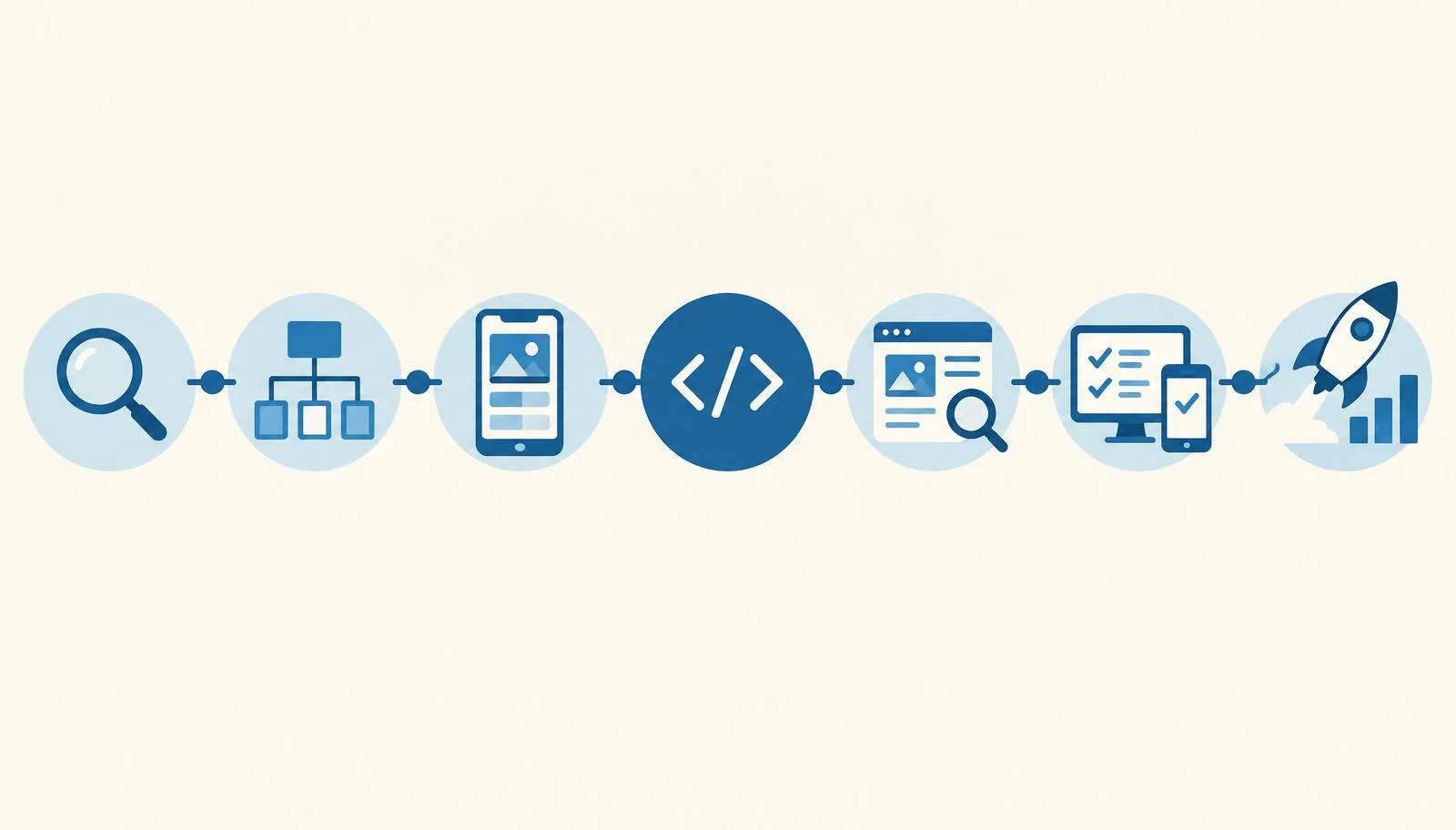
Discovery, sitemap, visual design, development, content and SEO, testing, launch. Original illustration.
- Discovery. Define goals, audience, competitors, and the one action visitors should take.
- Sitemap and wireframes. Plan pages and layouts before visual design.
- Visual design. Build the look and feel, starting with mobile layouts.
- Development. Turn approved designs into a working site with a CMS you can manage.
- Content and SEO setup. Add copy, optimized headings, metadata, and image alt text.
- Testing. Check devices, browsers, forms, speed, and accessibility.
- Launch and monitoring. Set up analytics and Google Search Console, then review real-user performance.
How to prepare before you start
- Your goal: more enquiries, online orders, bookings, or credibility.
- Two or three example sites you like, and what you like about each.
- Your content: logo, brand colours, service descriptions, photos, and testimonials.
- A list of must-have features: forms, a WhatsApp button, booking, payments, or a blog.
- Your budget range and deadline, so the scope can be matched to both.
Even rough notes help. A designer who understands your goals can suggest what to build first and what to add later.
What actually converts visitors into enquiries
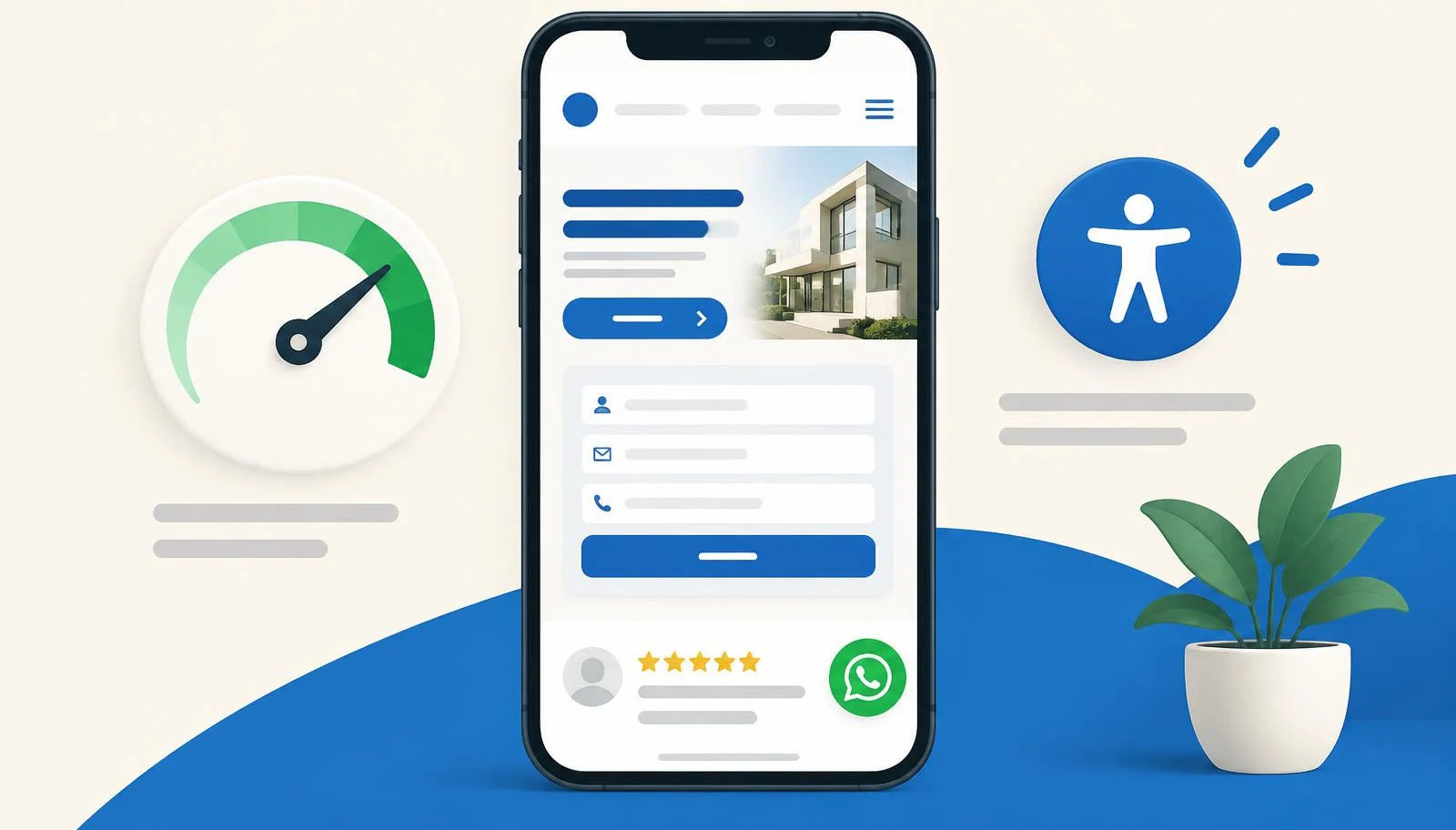
One clear action, a short form, real proof and easy contact options. Original illustration.
A site converts when visitors quickly understand what you offer, trust you, and find it easy to act. Practical elements that help:
- A clear value proposition at the top of the page. Say what you do, for whom, and where.
- One main call to action per page. “Request a quote” or “Book a call” works better than five competing buttons.
- Short forms. Ask only for what you need to follow up.
- Proof. Real testimonials, work samples, and credentials.
- Visible contact options. Phone, WhatsApp, or a form, depending on how your customers prefer to reach you.
- Mobile-first layout. Many visitors arrive on phones, and Google primarily uses the mobile version of content for indexing, as described in Google’s mobile-first indexing documentation.
Performance, accessibility and SEO basics
Speed and responsiveness. Google’s Core Web Vitals measure loading (Largest Contentful Paint), responsiveness (Interaction to Next Paint), and visual stability (Cumulative Layout Shift). The commonly cited “good” targets are LCP of 2.5 seconds or less, INP of 200 milliseconds or less, and CLS of 0.1 or less, measured at the 75th percentile of real visits. web.dev explains how these thresholds were defined. Common fixes include compressing images, limiting heavy third-party scripts, and setting image dimensions to prevent layout shifts.
Accessibility. Accessible design helps more users and reduces risk. The W3C’s WCAG standards are the main reference: enough colour contrast, keyboard navigation, descriptive alt text, and labelled form fields.
SEO foundations. Crawlable pages, descriptive titles, logical headings, and genuinely helpful content matter more than tricks. Google’s SEO Starter Guide is a good primary reference. No design can guarantee rankings, but a well-structured site gives your content a fair chance.
Choosing a platform
If you already have a website and want a fresh look, a full redesign starts from $499.
Approach
Best for
Trade-offs
WordPress
Content-led sites, blogs, flexible CMS needs
Needs regular updates and plugin discipline
React / Next.js
Custom, performance-focused web apps
More development effort
Website builders
Very simple sites
Pick the platform based on your content needs, budget, and who will manage the site day to day. Learn more about WordPress development and React / Next.js development.
Choosing a design partner
Evaluate agencies and freelancers on:
- Process clarity: Do they explain stages and deliverables?
- Relevant work: Can they show projects similar to yours?
- Scope transparency: Are revisions, content, and support clearly defined?
- Post-launch support: Who handles updates and fixes?
- Communication: Do you get a named contact and regular updates?
Questions to ask before you hire
- Who will own the design files, code, and content after launch?
- Which platform will the site use, and can I manage it myself?
- How many revision rounds are included?
- What is the expected timeline, and what do you need from me to keep it?
- How will the site be tested on mobile devices?
- What happens if something breaks after launch?
- Are hosting, domain, and plugin costs included or separate?
Clear, direct answers are a good sign. Vague answers usually lead to delays later.
Tricity and international considerations

Tricity and nearby areas
Local businesses benefit from clear location details, a Google Business Profile, and fast mobile pages. Stack Decode’s serving areas, including Chandigarh, Panchkula, Mohali, Zirakpur, Pinjore, Kalka, and Parwanoo, are listed on our locations page. Here is how needs differ slightly across these areas:
- Chandigarh: Businesses here often compete with many established brands, so a web designing company in Chandigarh should focus on clear positioning, strong proof, and fast mobile pages.
- Panchkula: If you are evaluating a web development company in Panchkula, check that they can support clinics, schools, and professional services with appointment and enquiry forms.
- Mohali: Website development in Mohali often serves startups and IT-led businesses that need a quick first launch and room to scale.
- Zirakpur: Retail, real estate, and hospitality businesses commonly look for web design services in Zirakpur that make listings, menus, and contact details easy to find on a phone.
- Pinjore: Pinjore is Stack Decode’s home base. Local shops and service providers can benefit from web development services in Pinjore that keep the site simple, fast, and easy to update.
- Kalka: A web development company in Kalka should be able to build a straightforward site for small shops and services without unnecessary extras.
- Parwanoo: For website development in Parwanoo, manufacturers and industrial suppliers usually need clear product information, downloadable specifications, and a reliable enquiry form.
Make local search easier. Keep your business name, address, and phone number identical on your site, your Google Business Profile, and any directories. Mention your service areas in natural sentences, embed a map on the contact page, and encourage genuine customer reviews. Avoid repeating city names unnaturally, since clear, helpful content works better than keyword repetition.
Working with international clients
When you compare a US-based agency with an India-based team, look at scope, process, and pricing side by side. Ask about time-zone overlap, written specifications, and who owns the final files, so the working arrangement is clear from day one.
Other international markets
We also serve clients targeting Canada, Australia, and the UAE / Dubai. Each market has its own expectations:
- Canada: If you serve Quebec, plan for both English and French content. Review the federal privacy law (PIPEDA) and any provincial rules that apply to your business.
- Australia: Check the Privacy Act 1988 and Australian Consumer Law, especially for pricing and claims shown on your site.
- UAE / Dubai: Offer English and Arabic where relevant, with right-to-left layout support, and review the UAE’s personal data protection law.
Rules change, so confirm requirements for each market with a qualified professional before you launch.
Privacy and consent
Privacy law affects forms, cookies, and analytics:
- India: The Digital Personal Data Protection Rules, 2025 were notified in November 2025 and are being implemented in phases. See the official phased-compliance memorandum and check MeitY for current timelines. This is general information, not legal advice.
- UK: UK-focused sites need to handle cookie consent and personal data carefully, including how consent banners, privacy notices, and analytics work together. GDPR-Ready Website Design for UK Businesses: Cookie Consent, Privacy and Speed (coming soon) covers consent, privacy, and page speed in detail. The UK regulator’s guidance is available from the ICO.
Industry considerations
Needs vary by sector:
- Photography and videography: fast image galleries and enquiry forms
- E-commerce: product discovery, checkout flow, and payment options
- Healthcare and clinics: appointment booking and careful handling of personal data
- Restaurants: menus, reservations, and location details on mobile
- Real estate: listings, search filters, and lead forms
- Law firms: practice-area clarity and consultation requests
- Education: course details and admissions information
- Student portfolios: projects, skills, and personal branding
After launch: maintenance and measurement
Launch is the start, not the finish. A simple routine keeps the site healthy and shows what to improve.
- Weekly: check that forms, calls, and WhatsApp buttons work, and reply to enquiries quickly.
- Monthly: review traffic, top pages, and enquiry sources in your analytics, and check the Core Web Vitals report in Google Search Console.
- Regularly: update the CMS, themes, and plugins, and keep tested backups.
- Quarterly: refresh outdated content, add new work or testimonials, and test key pages on a phone.
Common mistakes and how to avoid them
- Starting with design before goals. Decide the action you want visitors to take first.
- Comparing quotes on price alone. Compare scope, support, and ownership.
- Ignoring mobile. Design for phones first.
- Heavy visuals and scripts. They slow pages and hurt user experience.
- No content plan. Placeholder copy delays launch and weakens SEO.
- Skipping maintenance. Outdated software creates security and reliability risks.
- No measurement. Without analytics, you can’t improve conversions.
About Stack Decode Web and IT Solutions and the author
This guide is written by Anmol Verma, founder of Stack Decode Web and IT Solutions, a web design and development company based in Pinjore, Haryana. Anmol has been building websites and mobile apps since 2017, and we have delivered 200+ projects for clients across 25+ countries. The studio itself launched in January 2025, and you can read more on the About Us page.
The advice here comes from real project work. One example is AB Motion, a wedding photography and videography business in Houston, Texas, for which Stack Decode Web and IT Solutions built a custom WordPress website and still provides monthly maintenance. You can see more projects on the Our Work page, and we are also listed on Clutch, DesignRush and GoodFirms.
Here is how a typical project starts: a free discovery call, a free homepage mockup within 48 hours, a written plan with scope, timeline and cost, and post-launch support through monthly maintenance plans that start at $49 per month. The company is GST-registered in India (GSTIN 06AZIPV9734F1ZU), and you can contact the team or book a free discovery call to discuss your project.
Related guides in this series
This guide gives the big picture. For more detail on specific needs, explore these articles:
- Website Design Cost in Chandigarh: What Businesses Actually Pay (coming soon): a local look at pricing and what affects it.
- Website Development for Mohali Startups: MVP Site vs Full Build (coming soon): how to choose between a quick launch version and a complete site.
- Web Design Outsourcing for US Businesses: Working With an India-Based Team (coming soon): how to work with an India-based team across time zones.
- GDPR-Ready Website Design for UK Businesses: Cookie Consent, Privacy and Speed (coming soon): privacy and performance basics for UK audiences.
- Website for Small Shops and Services in Kalka: Simple Plan, Real Results (coming soon): a simple, practical plan for small local businesses.
- Web Design and Development Guide: Tricity to Worldwide: the full overview of working with an Indian web team.
Conclusion
The best website design India businesses can invest in, or anywhere, is the one that fits your goals, budget, and audience. Define scope clearly, follow a structured process, and build for speed, accessibility, and clear calls to action. Whether you are a local business in the Tricity or an overseas brand comparing agencies in the US, UK, Canada or Australia with an India-based team, the same principles apply. To discuss your project, explore Stack Decode’s web design and development services or review the pricing page to see how a project could be scoped.
Frequently asked questions
How much does website design cost in India?
It varies with page count, custom design, functionality, platform, and content needs. At Stack Decode, done-for-you plans start at $50/month plus a $30 one-time setup fee, and custom projects start at $499 (all prices in USD). Compare quotes on scope rather than headline price. See the pricing page for current options.
How long does a website project take?
Simple sites can take a few weeks, while complex builds take longer. Timelines depend largely on how quickly content and feedback arrive.
Should I choose WordPress or a custom build?
WordPress suits content-led sites and non-technical editing. Custom frameworks suit complex, performance-critical applications.
Do I need a mobile-friendly website?
Yes. Google primarily uses the mobile version of content for indexing, and many visitors browse on phones.
What are Core Web Vitals?
They are Google’s measures of loading, responsiveness, and visual stability. See web.dev for details.
Does an Indian website need to follow data protection rules?
If it collects personal data, India’s DPDP framework may apply. Check the official timelines and consult a legal professional.
Can an Indian agency build websites for overseas clients?
Yes, as long as requirements, privacy rules, and communication processes are agreed upfront. This applies to clients in the US, UK, Canada, Australia, and the UAE.
Which areas near Chandigarh do Stack Decode Web and IT Solutions serve?
Stack Decode Web and IT Solutions serves Chandigarh, Panchkula, Mohali, Zirakpur, Pinjore, Kalka, and Parwanoo. The locations page lists each area in detail.